Why I Write What I Write
Acronyms expanded in this post: No central technical acronyms need expansion here.
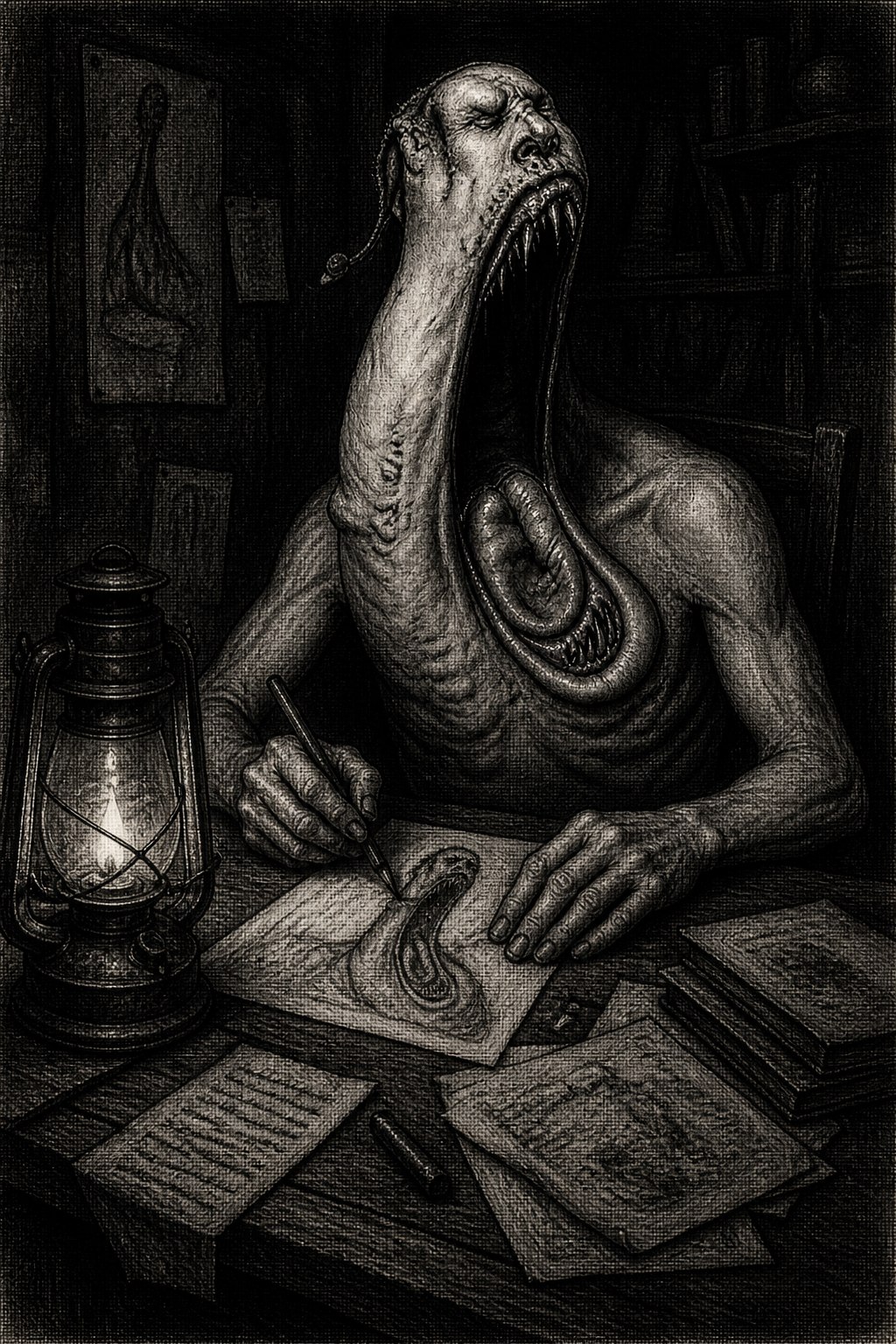
I write and draw because certain thoughts refuse to remain well-behaved tenants in the skull, and if they are not evicted into words, lines, grotesque faces, jokes, or little civic obscenities wearing a paper hat, they begin rearranging the furniture.
That is not a theory of art. It is plumbing.
Language is a magnificent instrument, but it is also a narrow pipe through which entire monsoons are expected to pass while wearing formal shoes. There are griefs that cannot walk through a sentence without limping. There are embarrassments that become ridiculous the moment they are named. There are private insanities that do not want explanation; they want a mask, a snarl, a limerick, a badly behaved cartoon animal with the face of a retired tax inspector. Art, or whatever amateur cousin of art I practice, lets the unpresentable arrive without requesting a visitor’s pass.
I do not mean art in the museum-polite sense, where a thin person in black stares at a rectangle and murmurs about negative space as if the canvas has defaulted on a loan. I mean denotative art, rough art, line-and-word art, safety-valve art, constipation-cure art. A door can be slammed. A face can be punched. A grievance can be pickled in silence until it becomes a family heirloom. Or one can draw the thing. Write the thing. Make the thing look just hideous enough that the truth underneath it stops pretending to be furniture.
This blog, if it is anything, is a record of those forced evacuations. Some of it is grief. Some of it is silliness. Some of it is the long, muted conversation one conducts with oneself when the rest of civilization has gone off to sell mutual funds, offer spiritual workshops, or explain patriotism through loudspeakers. Some of it is just the mind scratching at a patch of irritation until the skin gives way and a sentence appears.
I do not want to deny the darkness inside me anymore. Denial is a terrible interior decorator. It covers rot with curtains and then charges rent. There are things in a person that cannot be expelled by cheerfulness, digestion, or motivational quotes arranged over a photograph of a mountain. I have tried silence. Silence is overrated. It is advertised as wisdom mainly by people who benefit from others keeping quiet.
So I write with the door cracked open.
Not fully open. I am not interested in becoming a self-explaining exhibit under museum glass, with a brass plaque saying, “Here we observe the middle-aged male mammal converting dread into invective.” But I will leave clues. I will leave hints. I will leave enough scattered ash that another person, equally confused by the black weather in his own head, may say: ah, good, so this particular ugliness has occurred elsewhere in the species.
That may be useful.
Or it may not. One must not flatter oneself. Most writing does not rescue anyone. Most writing is a message in a bottle thrown into a sea already thick with bottles, plastic gods, election slogans, and the occasional dead fish wearing the expression of a man who has understood committee governance. Still, the act matters. The bottle matters to the person who throws it.
The grotesque characters I draw and describe are not necessarily portraits of others. They are not even reliably portraits of me. They are more like emissions from the furnace. A nose here, a wart there, a bureaucratic chin, a hungry cleric’s eye, a politician’s moist forehead, a demon with the expression of a school principal who has discovered funding. Are these mine? Partly. Are they society’s? Certainly. Are they literal? Only if one has the imaginative range of a stapler.
This is where people misunderstand dark work. They want an index. They want every deformity decoded. This skull means anger. This drool means childhood. This goat-headed accountant means father. This cracked tooth means unresolved anxieties about quarterly tax filings. No doubt something can always be made to mean something if you press hard enough. Interpretation is a very successful form of burglary. But not every image is a confession. Not every monster is autobiography with horns.
Sometimes a grotesque face is simply the weather of the mind passing through the hand.
When I draw, I am often not explaining. I am reducing pressure. I start a doodle because something is itching. I keep going because the itch has a geometry. Then the line gathers its own little criminal momentum, and before long a face appears, usually the kind of face that would be denied admission to a respectable Bengali wedding unless it came with property documents. Then I stop, or I write, or I attach some title to it afterward, and the title may be accurate, decorative, dishonest, accidental, or merely convenient. Human meaning is often assembled after the fact, like furniture from a box with three missing screws and instructions translated by a machine that resents you.
This is why I am suspicious of my own labels.
A title may describe the mood of the day, not the engine of the image. A caption may be a joke thrown over a hole. A blog post may be a postmortem performed on a body that was never alive in that way. The mind does not always compose in tidy cause and effect. It oozes, collides, misfiles, fabricates, contradicts, and occasionally produces a sentence with the elegance of a startled mongoose. To over-analyze every fragment is to take a hammer to a moth and then complain about the loss of detail.
Still, I analyze. Of course I do. I am incurable.
But the analysis is not the source. It is the autopsy.
I write also because the world has become so preposterous that ordinary description now seems underdressed. Satire used to exaggerate reality. Now it often arrives late, sweating, and discovers reality already wearing the fake mustache. A man can lie in public, be caught, deny the catching, denounce the catcher, rename the room, sell tickets to the scandal, and be praised for strategic clarity by someone with a podcast microphone and teeth like sponsored porcelain. What is the satirist supposed to do with this? Add a hat?
The grotesque has trouble competing with the news.
This is especially true in societies where people have been trained to treat symbols as relatives. A country becomes a mother. A party becomes a faith. A flag becomes a sedative. A leader becomes an uncle who must not be questioned because he once looked stern near a river. The state, that enormous paperwork beast with a police station for a tail and a revenue office for a stomach, is spoken of as if it were a wounded aunt. This sentimental confusion is not harmless. It is how adults volunteer to be managed by myths while congratulating themselves on realism.
To be politically correct, in that environment, would not merely mean being polite. It would mean pretending not to see. It would mean developing a civic cataract and calling the blur harmony. India has many healthy volunteers for this sort of blindness. Some are elected. Some are appointed. Some are self-appointed guardians of civilization, which usually means they have found a convenient stick and a crowd willing to confuse cruelty with conviction.
I have never been good at euphemism. Euphemism is often just cowardice in clean underwear. There are situations where tact is decent and necessary; there are others where tact is simply the ribbon around a brick. Too many people want language softened not because it is inaccurate, but because accuracy has begun chewing the upholstery. They prefer mealy-mouthed pleasers, the devotional whisperers, the professional nodders, the people who can discuss sewage as “legacy water emotion.” I cannot do it. Or rather, I can, but doing it makes me feel as if I have shaken hands with damp bread.
This does not mean I want to harm anyone. I am not a revolutionary. I am barely a logistical event. I am a speck of private weather with a keyboard, a stomach vulnerable to common flu, and an ambition so poorly monetized that even capitalism has stopped returning my calls. If anyone feels the need to bloody my nose over a cartoon, a sentence, or an insult uttered by one of my fictive goblins, I must warn them that the blood loss would be dramatically inefficient. They would not be defeating a danger. They would be inconveniencing a minor organism.
And yet people do get offended.
Of course they do. There are far too many egos loose in the world, most of them dressed as principles. Someone is always ready to feel wounded on behalf of a god, a nation, a party, a profession, a dietary preference, a dead ancestor, or a future fantasy of themselves as morally superior. This is why satire often enters through character. An insult from a salacious cartoon beast is less corrosive than an insult from a man standing upright in his own name. The mask gives everyone a little space. It says: relax, you are being attacked by a hallucination with dental problems.
But the mask does not always help. People struggle with truth not because truth is hidden, but because truth is rude. It turns on the light without permission. It exfoliates assumptions. It reveals the damp patch on the ceiling, the unpaid moral bill, the little shrine erected to self-deception in the drawing room. Most of us would rather not know how much of our virtue depends on convenience, how much of our patriotism depends on performance, how much of our decency depends on the absence of pressure.
That is why cringe sometimes remains cringe. The satirical payload requires a thinking mind, perhaps even a slightly cracked one. Without that, exaggeration is mistaken for confession, filth for filth, darkness for pathology, irreverence for malice, and a joke for a police report waiting to happen.
The material in these posts comes from my inner monologue, but not in a clean autobiographical way. It is not a diary with better lighting. It is more like a thermometer recovered from a shipwreck. You may see the mercury, but the labels are gone. Is it measuring fever, room temperature, climate change, or the emotional condition of a man watching public debate collapse into slogan soup? Hard to say. The reading is real, but the unit has floated away.
That matters.
A grotesque drawing may indicate that something is moving in me, but it does not explain what. A satirical paragraph may carry anger, but anger at what? A person? A class? A country? A memory? A falsehood? A digestive disturbance? Human beings are superb confabulators. We tell ourselves stories after the fact and then mistake the narration for the engine. If we cannot laugh at our own confabulations, we begin to take our little species too seriously, and from there it is only a short walk to uniforms, manifestos, and men with microphones shouting about purity.
I use revulsion sometimes as a test. Not a noble test. Not even a reliable one. More like an imaginary critic I have invented and then insulted before he has time to dislike me properly. If an image repels, it at least exists. If a sentence has teeth, it may bite through the rind. The danger, naturally, is that darkness becomes a costume. One can become merely decorative in one’s ugliness, a boutique monster, a curated sewer. I know this. I do not always avoid it.
But when you describe darkness, it is no longer entirely dark.
That is the relief.
The worth of art is a social problem disguised as an aesthetic one. A work becomes valuable when enough people agree to behave as if it is valuable, and the first person to say so risks looking like a fool unless supported by money, mystery, institutional furniture, or death. Death is especially useful. The dead cannot object to being improved. Once dead, an artist may be rearranged, polished, explained, simplified, sanctified, exploited, and turned into an anecdote by people with better shoes. A struggling cave painter becomes evidence of cosmic visitation. A madman becomes a visionary. A difficult person becomes “ahead of his time,” which is what we call people after their time has safely run out.
Van Gogh sold almost nothing in his lifetime and became a mountain after death. William Blake looked, to much of his era, like an eccentric operating outside the licensed corridors of seriousness. Then time performed its usual laundering service. Distance adds mystery. Scarcity adds perfume. Biography fills gaps. Markets arrive with measuring tape. The ignored become prophetic if the right people can profit from the prophecy.
I do not expect that. It would be absurd. But absurdity has never prevented a man from entertaining himself.
The digital world makes even posthumous fantasy ridiculous. In earlier times, neglect at least had the decency to gather dust. Papers sat in trunks. Sketches survived in drawers. A future nephew, hungry or sentimental, might discover them and invent a legacy. Now everything floats in accounts, servers, expired domains, lost passwords, broken links, and platforms run by companies whose moral imagination ends at user engagement. Unless you are noticed, you are not preserved. You are compressed, migrated, deprecated, forgotten, deleted, or absorbed into some training sludge where your best sentence becomes half a probability inside a cheerful machine explaining omelettes.
If I disappear, perhaps someone with chutzpah will claim the scraps. Good luck to them. Go ahead. Plunder the ruins. Misread me with confidence. Turn me into a misunderstood genius, a failed satirist, a mental health case, a minor Calcutta crank, an underground visionary, or a cautionary tale about broadband and bitterness. I will be dead and therefore finally eligible for flexible branding.
But while alive, I do this for a simpler reason.
I like doing it.
That sounds childish, but it is the cleanest truth available. I draw because I like to draw. I write because sentences sometimes arrive with little boots on and begin kicking the inside of my head. I cherish the “I” in art, not because the self is sacred, but because the self is the only laboratory I have immediate access to. The collective “we” is grand, useful, and frequently fraudulent. The “I” is smaller, uglier, more slippery, but at least I can catch it in the act.
My indifference to audience is not complete. No writer who publishes is entirely indifferent. That is one of the little lies writers tell to look spiritually solvent. I would like to be read. I would like to be understood, at least by someone whose skull contains furniture not entirely purchased from the showroom of public opinion. But I do not usually write with a future onlooker in mind, except a future version of myself who may someday ask, with some irritation, “What the hell were you trying to survive here?”
That future self is enough.
I am, by all practical measures, an amateur. My drawings are amateurish. My verses, limericks, and grotesqueries are amateurish. I do not make a living from them. I have no academy behind me, no gallery, no patron, no respectable machinery of cultural laundering. What I have is nerve. A certain intrepidity. A refusal to file the sharp edges down until everything resembles the moral furniture of a dentist’s waiting room.
That may not be art.
It may be tic.
A compulsion. A private neurological housekeeping ritual. A need to exfoliate the makeup from the face of things until the skull appears, which, inconveniently, is often the most honest part. I look at society, politics, religion, respectability, family, class, public virtue, private cowardice, and the great decorative cake of human self-importance, and I want to scrape. Not always wisely. Not always fairly. But persistently.
The skull interests me.
So do absences. Desolation has always felt oddly kindred. Not comforting exactly, but recognizable. Some people find assurance in abundance: crowded rooms, applause, busy calendars, public affection, institutional validation, a clean LinkedIn biography marching forward like a disciplined clerk. I often find my guarantees in what is missing. The empty landscape. The failed ship. The majestic mast stuck in the doldrums, sails hanging like old excuses. I have a talent for steering there. If there is a windless patch in the ocean, I can find it with the instinct of a migratory curse.
But even the doldrums have texture.
That is where the writing starts. In the stalled place. In the absurd place. In the room where ambition and futility sit across from each other like relatives after a property dispute. These posts are thought experiments about the unpleasant and the unremarkable. They let me step away from myself, apply the brakes, reduce the voltage, cool the wire. They are curated fulminations from a closet thinker, filaments of figment, visualized babble, fiction with stains on its shirt, sometimes stranger than fiction because fiction has the decency to organize itself.
Life does not.
Life is montage. Discolored, jump-cut, badly mixed, full of missing context and recurring characters who refuse to learn. My art, such as it is, comes from that montage. It is not a polished doctrine. It is not a manifesto. It is not a therapeutic brochure. It is the residue of private weather, civic disgust, comic helplessness, metaphysical nausea, and the stubborn little pleasure of making something rather than merely suffering something.
That distinction matters.
To make is not necessarily to heal. Healing is too clean a word, too scented-candle. But making changes the posture of suffering. It turns the sufferer, briefly, into a fabricator. It gives shape to pressure. It gives rhythm to dread. It says that even if the mind is a badly governed municipality, one can still build a crooked tea stall somewhere and serve hot language to whoever wanders by.
That is why I write what I write.
Not to be correct. Not to be admired. Not to be family-friendly. Not to be explained into harmlessness. Not to pretend darkness is virtue or vulgarity is courage. Not to become the brave little mascot of authenticity, that overmarketed vegetable.
I write because something in me keeps knocking from the inside, and I would rather open the door with a pen in my hand than wait for it to break the furniture.